
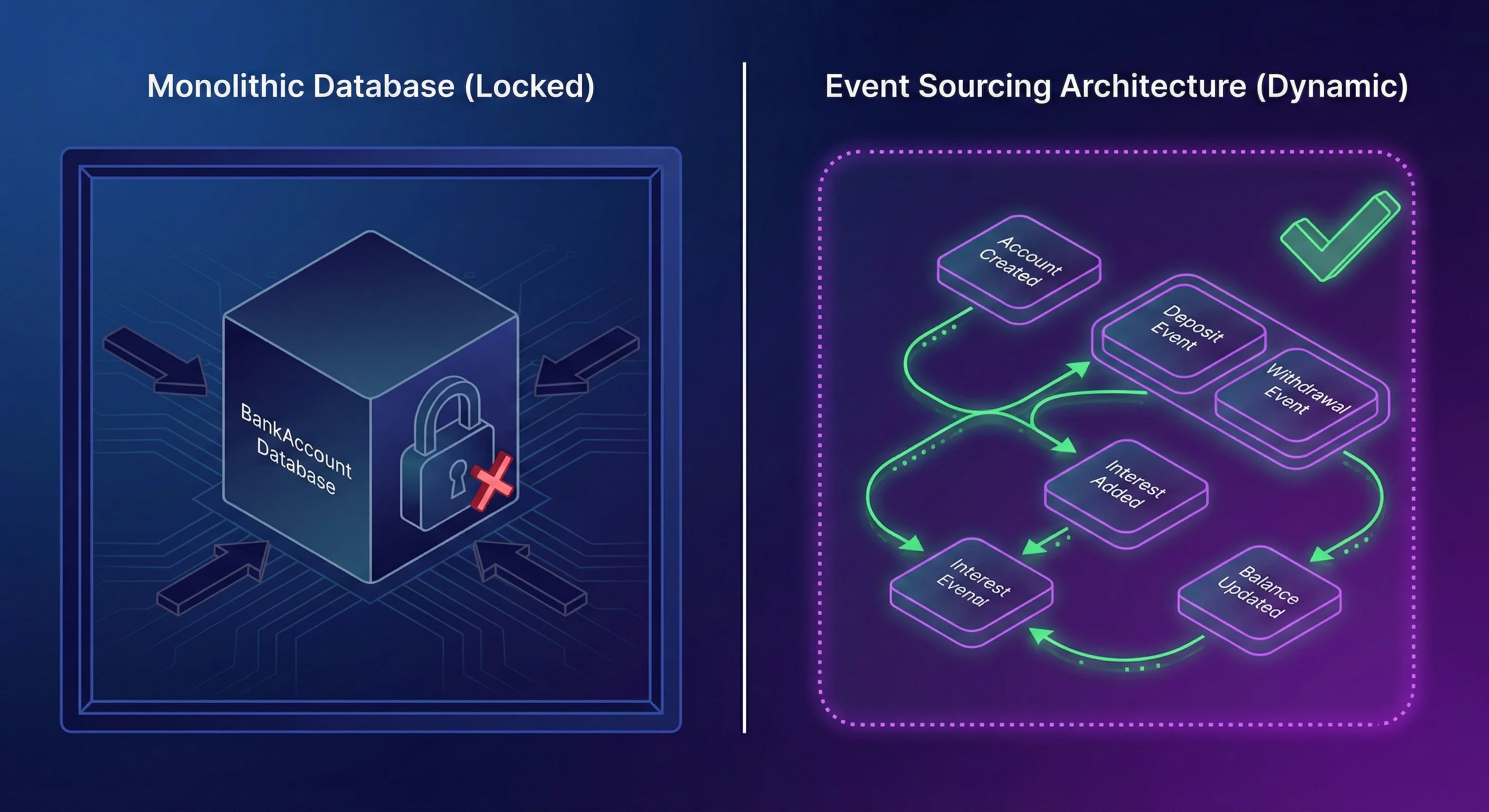
- I'm architecting a financial platform. Event Sourcing makes perfect sense: account transactions, audit trails, temporal queries. We define
BankAccountas our aggregate root.
Two years later, the business adds investment accounts. Then loans. Then credit cards.
Our BankAccount aggregate doesn't fit anymore. Changing it means replaying millions of events through new logic. Splitting it means complex event migration. We're stuck.
Event Sourcing's Biggest Challenge
The pattern: your system can evolve because events are immutable facts.
The reality: your aggregate boundaries are permanent. Once you've defined what "account" means, changing that definition is expensive and risky.
I've hit this wall on two different projects. Both times, we chose a different architecture rather than deal with aggregate evolution.
Then Axon Framework 5 introduced Dynamic Consistency Boundary (DCB). It claims to solve this problem with a fundamentally different approach.
What Traditional Aggregates Get Wrong
In Event Sourcing, aggregates define your consistency boundaries. This seemed like a good architectural decision:
- Clear boundaries
- Strong consistency guarantees
- Well-understood DDD patterns
But business evolves faster than architecture adapts.
Real scenario: BankAccount evolution
Year 1: Simple checking accounts. BankAccount aggregate works perfectly.
Year 2: Business adds savings and investment accounts. Now what?
- Rename
BankAccounttoFinancialAccount? (Requires event migration) - Create
InvestmentAccountaggregate? (Duplicate logic) - Use aggregate inheritance? (Complex in Axon)
Year 3: Cross-account transfers need consistency across TWO accounts. Traditional solution: heavyweight saga orchestration for what should be a simple operation.
This is where most Event Sourcing projects start questioning the pattern.
How Dynamic Consistency Boundary Actually Works
DCB isn't an incremental improvement. It's a different way of thinking about consistency boundaries.
Key concept: Consistency boundary defined per operation, not per aggregate type.
Traditional Event Sourcing:
- One entity type = one aggregate = one fixed boundary
- Change the aggregate? Migrate all events.
Dynamic Consistency Boundary:
- Operation-specific consistency scope
- Multiple entities in one transaction
- Aggregates can evolve without event migration
The DCB API
Here's what DCB looks like in Axon Framework 5:
1. Tag Events with Multiple Entity IDs
public record MoneyTransferredEvent(
    @EventTag(key = "fromAccountId") String fromAccountId,
    @EventTag(key = "toAccountId") String toAccountId,
    String transferId,
    BigDecimal amount
) {}
The @EventTag annotation tells Axon Server to index this event under multiple entity streams. One event, multiple perspectives.
2. Entities Respond to Tagged Events
@EventSourcedEntity(tagKey = "accountId")
public class Account {
    private String accountId;
    private BigDecimal balance = BigDecimal.ZERO;

    @EventSourcingHandler
    void evolve(MoneyTransferredEvent event) {
        // This handler fires when event matches THIS account's tag
        if (event.fromAccountId().equals(this.accountId)) {
            this.balance = this.balance.subtract(event.amount());
        } else if (event.toAccountId().equals(this.accountId)) {
            this.balance = this.balance.add(event.amount());
        }
    }

    public void withdraw(BigDecimal amount) {
        if (balance.compareTo(amount) < 0) {
            throw new IllegalStateException("Insufficient funds");
        }
    }
}
The @EventSourcedEntity(tagKey = "accountId") tells Axon to load events where @EventTag(key = "accountId") matches this instance.
3. Command Handler with Multiple Injected Entities
@CommandHandler
void handle(
    TransferMoneyCommand command,
    @InjectEntity(idProperty = "fromAccountId") Account fromAccount,
    @InjectEntity(idProperty = "toAccountId") Account toAccount,
    EventAppender eventAppender
) {
    // Both accounts are loaded into the consistency boundary
    fromAccount.withdraw(command.amount());
    toAccount.deposit(command.amount());

    // Atomic - both succeed or both fail
    eventAppender.append(
        new MoneyTransferredEvent(
            command.fromAccountId(),
            command.toAccountId(),
            command.transferId(),
            command.amount()
        )
    );
}
The @InjectEntity annotation pulls entities into the handler's consistency scope. The framework ensures atomicity across all injected entities. The idProperty parameter is optional. When omitted, Axon resolves the entity ID via @TargetEntityId on the command payload or through a custom idResolver.
What Changed From Axon 4
No more static AggregateLifecycle:
// Axon 4
AggregateLifecycle.apply(new MoneyTransferredEvent(...));

// Axon 5
eventAppender.append(new MoneyTransferredEvent(...));
Explicit EventAppender dependency makes event publication visible in method signatures. Better testability, clearer dependencies.
Configuration is explicit:
var configurer = DefaultConfigurer.defaultConfiguration()
    .registerCommandHandler(config ->
        new TransferMoneyCommandHandler()
    );

configurer.start();
No magic Spring autowiring. You register components explicitly through DefaultConfigurer's fluent API.
When This Actually Helps
Scenario: Financial Account Evolution
Phase 1: Simple bank accounts
One account type, clear boundaries. DCB provides no advantage.
Phase 2: Multiple account types
Traditional: Create separate aggregates or use inheritance (complex).
DCB: Same Account entity, different tag values. No migration needed.
Phase 3: Cross-account operations
Traditional: Saga coordination (100+ lines with error handling).
DCB: Direct command handler with multiple entities (30 lines).
What DCB Solves
- Aggregate evolution - Add fields, change structure without event migration
- Cross-entity operations - No sagas for simple coordination
- Business model changes - Adapt boundaries, keep events unchanged
What DCB Doesn't Solve
- Poor domain modeling - Still need good DDD skills
- Event schema evolution - Still need versioning for event structure changes
- Distributed transactions - Sagas still needed across bounded contexts
- Complex workflows - Timeouts, compensation still require sagas
Dependencies and Setup
Maven (Axon 5.0.2):
<properties>
    <axon.version>5.0.2</axon.version>
</properties>

<dependencyManagement>
    <dependencies>
        <dependency>
            <groupId>org.axonframework</groupId>
            <artifactId>axon-framework-bom</artifactId>
            <version>${axon.version}</version>
            <scope>import</scope>
            <type>pom</type>
        </dependency>
    </dependencies>
</dependencyManagement>

<dependencies>
    <dependency>
        <groupId>org.axonframework</groupId>
        <artifactId>axon-eventsourcing</artifactId>
    </dependency>
</dependencies>
Note: Axon Framework 5.0.0 was released in November 2024. The examples use 5.0.2 (January 2025).
The Honest Assessment
If I had DCB in 2023, would I have stuck with Event Sourcing for that financial platform?
Probably.
The aggregate evolution problem was real. DCB would have given us a viable path forward instead of choosing between:
- Living with awkward aggregate design
- Complex event migration
- Abandoning Event Sourcing
But Event Sourcing still isn't always the answer. DCB makes it viable for more use cases, but doesn't eliminate the complexity, operational overhead, or learning curve.
The pattern: AI and better tooling enable faster development. Cost collapse makes patterns accessible. Expert tools become available to more developers. But complexity doesn't disappear - it shifts.
DCB shifts Event Sourcing complexity from "aggregate evolution" to "understanding when to use which pattern." That's a better trade-off.
Try It Yourself
Working example code: github.com/maxzillabong/axon-5-dcb-demo
What's in the repo:
- Complete DCB implementation with
@EventTag,@EventSourcedEntity,@InjectEntity - Maven dependencies for Axon 5.0.2
- Working command handler with
EventAppender
Official resources:
- Axon Framework 5 Getting Started
- University Demo (official example)
- DCB Architecture Guide
- AxonIQ Blog: DCB Release
For AxonIQ: If I got any technical details wrong, let me know. Happy to correct.